Why Hot Water Supply Lines Under Slabs Fail First
In residential plumbing, over seventy percent of subterranean pipe failures occur on the hot water supply circuit rather than the cold side. If you live in Tustin, an active hot water slab leak repair Tustin emergency can develop rapidly due to the thermodynamics of embedded copper tubing. When your home's water heater cycles, hot domestic water at 120 to 140 degrees Fahrenheit surges through copper pipes encased in rigid concrete and dense gravel.
Copper is a malleable metal with a high thermal expansion coefficient. Every time a shower is run or dishwasher cycles, the copper pipe expands in length and diameter. When the tap is shut off, the pipe cools and contracts back to its resting state. Decades of thousands of thermal expansion cycles cause uninsulated copper lines to rub against jagged gravel aggregate, concrete slurry, and rebar ties. This continuous mechanical friction creates abrasion points that eventually wear through the pipe wall, producing a severe hot water line leak under slab Tustin homes experience as localized heating.
Recognizing the Distinct Warning Signs
Hot water slab leaks exhibit clear, unambiguous symptoms that distinguish them from cold line failures:
- Noticeable Warm Flooring: A distinct warm spot on floor Tustin homeowners discover while walking barefoot on linoleum, vinyl plank, carpet, or bathroom tiles is the hallmark indicator of an active hot-water rupture. In severe cases, the floor feels uncomfortably hot to the touch.
- Water Heater Running Continuously: If you observe your gas burner firing or electric heating elements humming 24 hours a day with no fixtures running, you have a water heater running constantly Tustin situation indicating pressurized hot water is escaping continuously into the foundation.
- Premature Depletion of Hot Water: Shower temperatures drop from hot to lukewarm within minutes because escaping water under the slab constantly drains your tank's reserve.
- Substantial Gas or Electric Utility Spikes: Soaring natural gas charges on your Southern California Gas Company bill or electric jumps on your utility bill indicate thousands of gallons of water being continuously heated and discarded into the soil.
- Steam or Mildew in Flooring Cavities: Warm vapor rising through the porous slab accelerates glue degradation beneath vinyl or laminate planks, causing buckling, bubbling, and foul mildew odor.
How Hot Water Leaks Are Found with Thermal Imaging
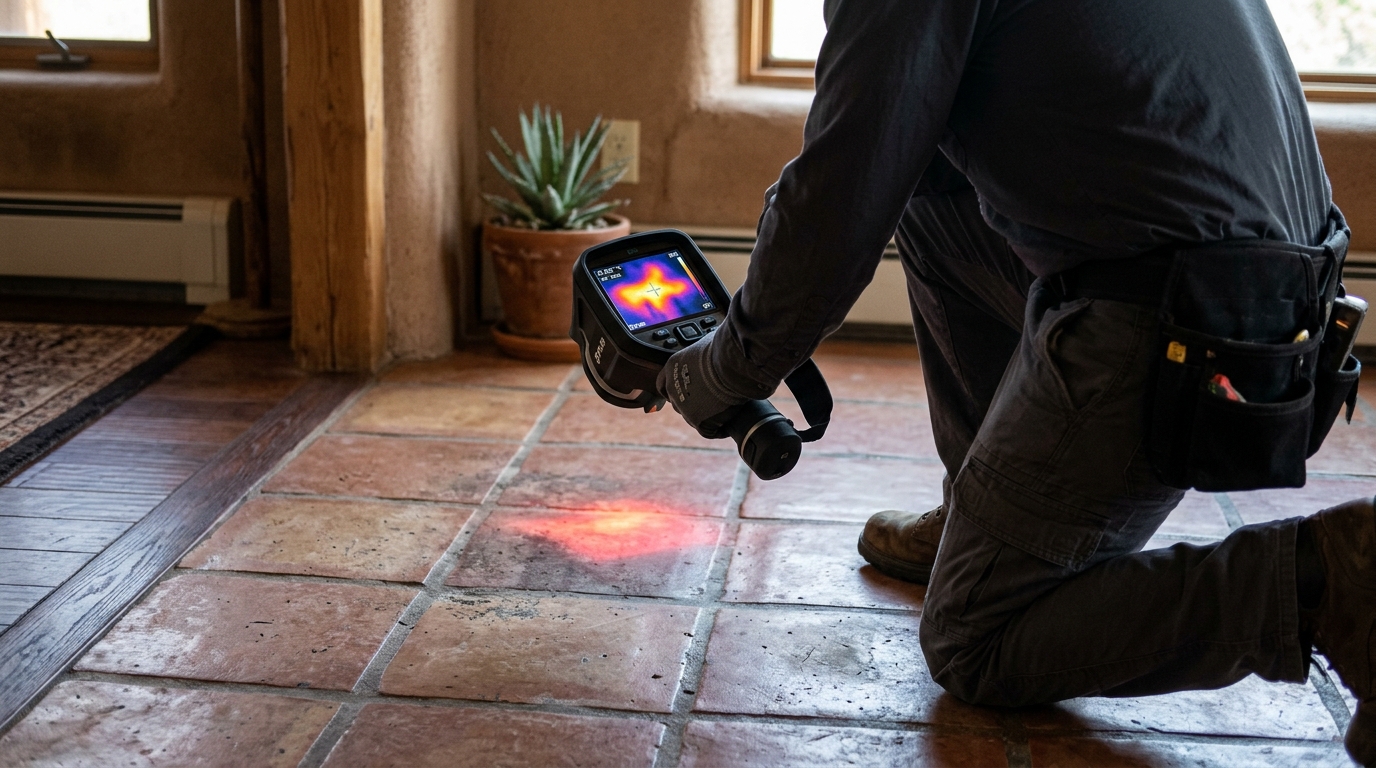
Unlike cold water leaks where acoustic listening is the primary detection tool, hot water lines provide a distinct infrared signature. Our diagnostic technicians deploy calibrated radiometric infrared cameras that capture minute surface temperature variations across your flooring surfaces. As escaping hot water saturates the concrete pad, it creates a radiant thermal bloom.
By mapping this thermal heat bloom against our digital pressure decay testing and electromagnetic line transmitters, we identify the exact pipe junction or fracture point without tearing up your floor. Once the pipe is mapped, we can provide immediate recommendations for either direct repair or modern bypass routing. Learn more about our comprehensive diagnostic instrumentation on our slab leak detection page.
Repair Options: In-Slab Spot Repair vs. Overhead Reroute
When dealing with a hot water slab leak, property owners must choose between opening the slab or routing new pipe overhead:
Option A: Direct In-Slab Spot Repair
Spot repair entails cutting through the finished flooring, jackhammering through the concrete foundation, digging out wet sand and gravel, and brazing a new copper section or brass slip coupling. While this approach stops the immediate leak, it has significant downsides for hot water lines: the surrounding copper remains embedded in abrasive gravel and will likely suffer another thermal-friction fracture just feet away within a few years.
Option B: Overhead Hot Line Reroute (Recommended)
An overhead reroute is widely recognized by plumbing engineers as the superior, permanent solution. Rather than tearing up your decorative tile or hardwood, our plumbers abandon the failed copper line beneath the slab entirely. A continuous run of high-grade cross-linked polyethylene (PEX-a) or insulated copper is installed from the water heater manifold, up through interior wall chases, across the attic or ceiling joists, and connected directly to the affected bathroom or kitchen manifold. For an in-depth breakdown of this process, visit our slab leak reroute guide.
Long-Term System Health & Repiping Considerations
If your home has suffered multiple hot water failures in recent years, your entire subterranean copper network may be reaching the end of its engineering lifespan. Local water chemistry, high municipal supply pressure, and decades of thermal stress take an inevitable toll. Review our guide to whole-house repiping and learn why upgrading your home's water lines prevents endless foundation emergencies. You can also explore our foundation slab leak repair in Tustin homepage for overall restoration protocols.
Frequently Asked Questions About Hot Water Slab Leaks
How do I test if a leak is on the hot or cold water line myself?
Locate the shutoff valve installed on the cold water inlet pipe directly above your water heater tank. Turn this valve completely clockwise to shut off supply to the heater. Next, check your municipal water meter. If the meter stops moving, the leak is located on your hot water circuit. If the meter continues to spin, the leak is on the cold water line.
Can a hot water slab leak damage my water heater?
Yes. When hot water escapes continuously under the foundation, your water heater operates nonstop to satisfy the demand. This continuous firing accelerates sediment buildup, overheats tank elements, exhausts gas burners, and can cause premature tank rupture.
Can a hot water leak cause mold growth under my floor?
Yes. The combination of heat, moisture, and enclosed darkness beneath floor coverings creates optimal conditions for rapid mold and mildew spore proliferation, often damaging baseboards and subflooring within 48 to 72 hours.